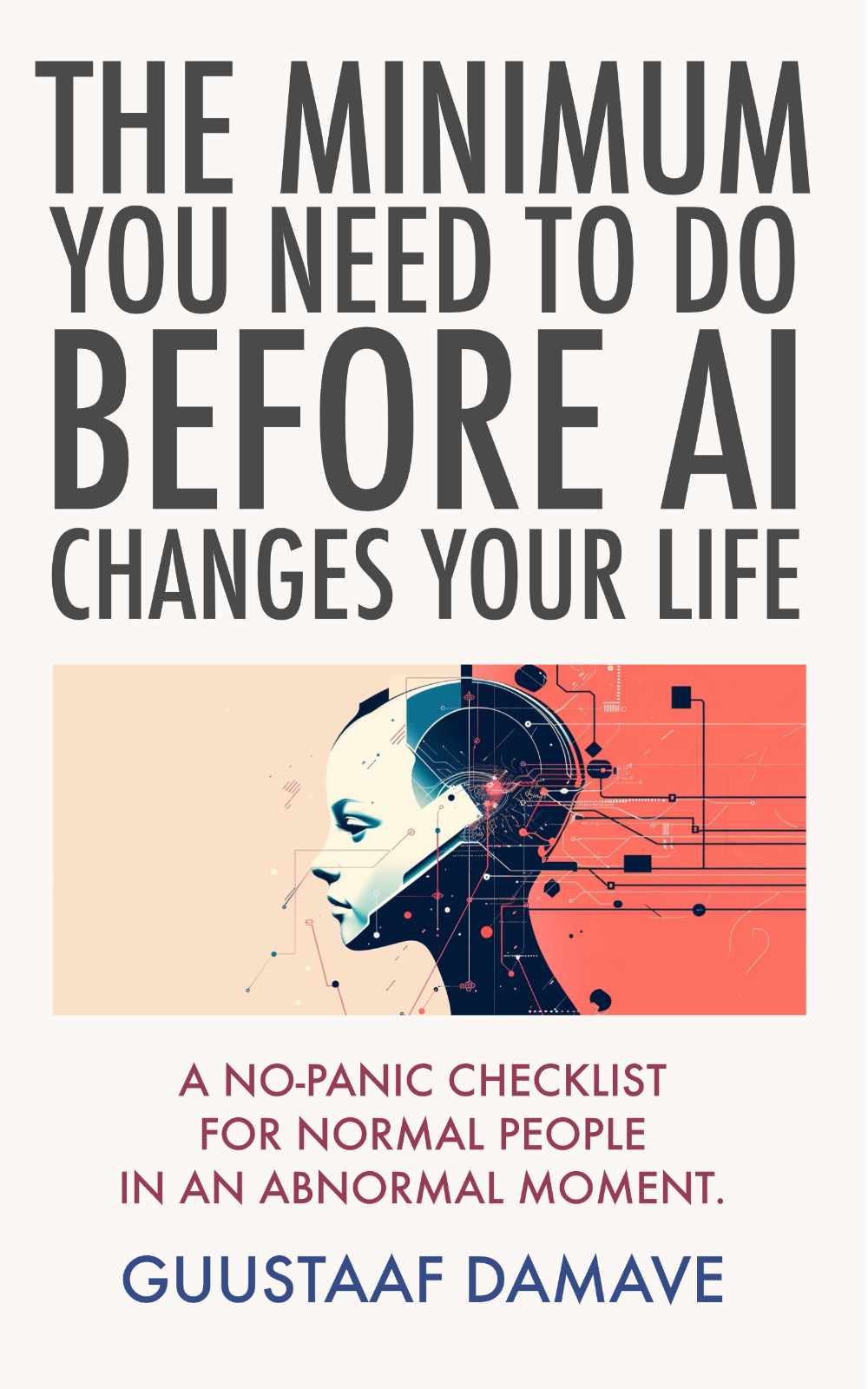
The Minimum You Need to Do
Before AI Changes Your Life
A no-panic checklist for normal people in an abnormal moment.
Paperback · Kindle · Audiobook
Most people reading this have done zero to prepare for the biggest economic shift in human history. Not through laziness. Through the very human tendency to normalize a slow-moving change until it arrives fully.
This book is not predictions. It is not theory. It is a checklist. Seven chapters, each covering a domain of life, each ending with a short list of things worth doing this week. If you read the whole book and do everything in it, you will have spent maybe a focused weekend and put yourself meaningfully ahead of almost everyone you know.
Honest, calm, specific, and short enough to actually finish.
What's inside
- Is My Income Safe?
- The Threat Nobody Takes Seriously Until It Happens to Them
- You Can No Longer Trust What You Read
- The Conversation to Have With Your Kids
- Start Using AI — the One-Hour Onramp
- What's Actually Coming — and When
- Staying Sane While All This Happens
Questions people ask
Is my income safe from AI?
Probably not in its current form. Two waves are hitting at once: routine information-processing work — customer service, data entry, bookkeeping, paralegal tasks — is being automated now, and entry-level jobs in law, finance, and software are disappearing before new graduates can get a foothold. Physical skilled trades (plumbing, electrical, carpentry) remain the most protected, for now. Chapter 1 walks through a quick two-week test for your own job and eight realistic side-income options.
How do I protect my family from AI voice-cloning scams?
AI can now clone a voice from three seconds of audio — convincingly enough to fool family members on the phone. It's already being used to fake emergency calls from a “child” or a “CEO” asking for an urgent money transfer; reported fraud losses hit $12.5 billion in 2025, up 25% year over year. The five-minute fix in Chapter 2: agree on a family code word nobody else can produce.
Can I still trust what I read online?
Not automatically. AI can generate convincing fake articles, fake expert quotes, and fake “consensus” — waves of generated comments that make a manufactured opinion look like a genuine groundswell — faster than anyone can fact-check them. Chapter 3's most reliable signal: if something makes you angry or afraid, that's exactly when to slow down, check the actual URL, and see whether more than one outlet is reporting it.
How do I talk to my kids about AI and their careers?
Focus less on job titles and more on what problems they want to solve, because the traditional ladder — degree, entry-level job, years of on-the-job learning — is losing its bottom rungs as AI absorbs junior-level work. What holds up: physical presence, genuine human relationships, and real AI fluency. Chapter 4 has the fuller version of this conversation, for kids and for your own career.
How do I actually start using AI?
Give it one real hour, not a test question. Chapter 5's four-step exercise: ask AI to explain something that's always confused you, have it draft something you've been avoiding writing, use it to plan something real in your life, then bring it an actual work task. ChatGPT, Claude, and Gemini all have free tiers — that's the whole barrier to entry.
What's actually coming with AI, and when?
The direction is settled, the timing isn't. White-collar professional services — legal research, accounting, journalism, coding — are already in the first wave. Logistics and transport are next, over roughly two to four years. Skilled trades follow in four to eight years as robotics catches up. Chapter 6 also asks the question underneath all of it: who ends up owning the machines?
How do I stay sane through the AI transition?
Notice which of three traps you default to — denial, paralysis, or doom-scrolling — because none of them help, and the antidote to all three is the same: small, completed actions. Chapter 7's other point: the things AI can't touch — physical experience, real human connection, craftsmanship, the fact that you're more than your job — are worth deliberately investing in.
Get the free worksheets
The companion worksheets to every checklist in the book — yours free when you subscribe to the weekly newsletter.